





The automotive paint protection film (PPF) industry is experiencing a massive paradigm shift. With the consumer demands of the invisible, long-term protection of vehicles at an all-time high, the materials utilized by the installation shops and regional distributors are subject to microscopic examination. The market has been marred by deceptive marketing over the years whereby the low-end films are sold as high-end solutions. The main conflict in this industrial divide is the basic struggle between two different types of polymers: Thermoplastic Polyurethane (TPU) and Polyvinyl Chloride (PVC).
To automotive styling companies, upscale detailing shops, and regional distributors who are considering their supply chain, the knowledge of the molecular, physical and economic differences between these materials is no longer a luxury, but a survival and profitability requirement. The sourcing choices you make today will directly determine the reputation of your shop, your overhead in labor, your retention rate of customers, and your profitability in the bottom-line in the next 10 years.
When you look at the landscape of pvc vs tpu PPF wholesale, the initial procurement cost is often a deceptive metric. A singular focus on the low cost of cheap roll prices completely overlooks the crushing latent costs of inefficiencies in installation, premature material breakdowns, and disastrous customer complaints. This detailed technical manual is engineered to suit B2B professionals, procurement managers, and technical installers. We will dissect the chemical foundations, performance metrics, and the Total Cost of Ownership (TCO) of both materials, providing a definitive roadmap to building a highly profitable, zero-complaint PPF operation.
Chemical Structures: The Molecular Core of TPU vs PVC
To understand why a film behaves the way it does on the hood of a vehicle, we must strip away the marketing jargon and examine the foundational polymer science. The physical distinction between TPU and PVC is not a consequence of the manufacturing adjustments; it is a consequence of their distinct macromolecular architectures.
Polyvinyl Chloride (PVC) is a rigid, brittle synthetic plastic polymer. It is the same raw material used in the production of hard industrial pipes and window frames. In order to render PVC usable in automotive wrapping, manufacturers are forced to change its physical properties by forcefully introducing colossal amounts of plasticizers (usually phthalates). These plasticizers wedge themselves between the polymer chains of PVC, occupying the free volume and enabling the chains to slide over each other, thus providing temporary flexibility. But this is a borrowed quality. The plasticizers are not chemically attached to the PVC backbone; therefore, they are bound to leak out of the material in the long run.
Thermoplastic Polyurethane (TPU), on the other hand, is a very sophisticated block copolymer and a true thermoplastic elastomer. It features a molecular structure made up of alternating “hard segments” (diisocyanates) and “soft segments” (polyols). The hard segments serve as physical cross-links, offering structural integrity, high tensile strength, and extreme chemical resistance. The soft segments act like microscopic coiled springs, providing the material with its natural, inherent flexibility without a single drop of external plasticizer.
In order to measure this basic rigidity and elasticity difference, engineers make use of a basic mechanical parameter called the Youngs Modulus.
Young’s Modulus is a measure of the stiffness of a solid material. It defines the relationship between stress (force per unit area) and strain (proportional deformation) in the linear elastic region of a material. The mathematical representation is:
E = Stress / Strain
Where E represents Young’s Modulus, Stress represents the tensile force applied, and Strain represents the extensional deformation.
In practical application for PPF:
- PVC possesses a relatively high Young’s Modulus, even when heavily plasticized. It is recalcitrant, rigid and very difficult to bend to intricate 3D forms. When you pull it, it will want to spring back with a viciousness or it will just rip.
- TPU features a tunable, much lower Young’s Modulus in its flexible state. It exhibits true elastomeric behavior. When stretched over a complex bumper contour, the soft segments uncoil seamlessly. When the mechanical stress is released, it maintains its integrity and securely hugs the substrate with minimal edge-lifting tension.
Performance Metrics: Durability, Flexibility, and Self-Healing
The molecular variations outlined above are the direct determinants of how these materials perform in the harsh, real-life environment of everyday driving. We can translate this underlying chemistry into quantifiable, naked-eye mechanical properties and performance metrics that dictate the quality of a PPF installation.
Elongation at Break and Tensile Strength
When an installer is wrapping a very complicated aerodynamic bumper, the film should be able to stretch a lot without tearing or leaving “stretch marks” (whitening of the film).
- Standard PVC films typically suffer catastrophic failure at an elongation of just 150% to 200%. If an installer pushes the material past this limit, the molecular bonds rupture, resulting in visible white lines or immediate tearing.
- Premium TPU films boast an elongation at break exceeding 400%. This massive working range enables technicians to comfortably drape the film across sharp edges and deep crevices, wrapping it seamlessly without losing structural integrity, tear resistance, or optical clarity.
Impact Resistance
The primary purpose of PPF is to provide superior abrasion resistance and absorb the kinetic energy of high-speed road debris. The special hard-soft segment matrix of TPU enables it to serve as a highly effective energy dampener. When a rock hits TPU, the soft segments compress to absorb the impact, while the hard segments prevent the object from penetrating to the clear coat. PVC, lacking this internal shock-absorbing structure, is highly susceptible to micro-fractures and complete puncturing upon impact.
The Mechanics of Thermal Self-Healing
The ability of TPU to self-heat thermally perhaps is the most important technological gap between the two materials, a feature that creates a technical barrier that PVC cannot technically cross.
This is not magic; it is thermodynamics. The surface of a premium TPU PPF is coated with a highly engineered polyurethane elastomer. When this surface is scratched by automated car wash brushes or road grit, the polymer chains are physically displaced, but not severed. Due to the “shape memory” effect that TPU has, the introduction of thermal energy causes a recovery process.
At a temperature of about 60°C (easily attained by pouring warm water over the panel or just by parking the car in the sun) the displaced polymer chains acquire sufficient kinetic energy to rearrange into their original, low-energy, highly ordered form. Deep scratches (up to 15 µm) vanish completely. PVC has no self-healing qualities whatsoever; all the scratches it gets are permanent damages to the looks of the vehicle.
Extreme Temperature Tolerance
Under extreme thermal stress, the differences become stark. When exposed to low temperatures that drop to -40°C in harsh winters, the plasticizers in PVC freeze, making the film glass-like and dangerously brittle; even the slightest impact will shatter the PVC film like ice. On the other hand, high-end TPU maintains its elastomeric flexibility and dampening qualities even at -40°C, remaining pliable and strong.
Weather Resistance: The Critical Role of Aliphatic TPU
Premature yellowing of films is the number one cause of catastrophic customer conflicts and warranty claims to any automotive styling business. Understanding weather resistance requires a deep dive into polymer degradation. One cannot just say that “TPU is superior to PVC.” In order to conquer your domestic market, you have to know the key difference in the TPU family itself: Aromatic TPU and Aliphatic TPU.
When PVC is exposed to ultraviolet radiation from harsh uv rays, the polymer backbone undergoes rapid photo-oxidation. The material literally burns at a microscopic level, shifting its color spectrum heavily toward yellow and brown.
However, cheap TPU can be equally disastrous. Aromatic TPU is commonly used in the production of entry-level PPF. Aromatic TPU has benzene rings in its molecular structure. These benzene rings are very unstable when subjected to UV photons. They absorb the UV energy, which breaks their double bonds, leading to heavy oxidation and rapid, irreversible yellowing. When a supplier is selling you a suspiciously cheap roll of TPU, it is most likely aromatic.
The ultimate solution for optical longevity is Aliphatic TPU.
Aliphatic TPU is produced without benzene rings. Its carbon chains are open and highly saturated, which makes the material to be mostly “transparent” to UV radiation. Because the UV energy cannot easily break these stable aliphatic bonds, the photo-oxidation process is virtually halted.
In industrial laboratories, this is quantified using Accelerated Weathering Testers such as the Q-Lab QUV chambers, following stringent ASTM standards. The color shift is measured by the Yellowing Index, or Delta YI.
- PVC and Aromatic TPU will experience a drastic increase in Delta YI in a few hundred hours of accelerated UV exposure.
- Premium Aliphatic TPU is engineered to maintain a Delta YI of less than 1.0 even after thousands of hours of intense UV bombardment. In context, a Delta YI of under 1.0 is entirely invisible to the human eye, ensuring a crystal-clear finish, which will last longer than the ownership of the vehicle.
Eco-Compliance: Halogen-Free Materials and Environmental Sustainability
Environmental compliance in the contemporary B2B environment is no longer a mere corporate social responsibility talking point, but a legal and trade requirement.
Polyvinyl Chloride (PVC) is a halogenated polymer, as the name suggests, due to its high chlorine content. PVC creates a highly toxic environmental impact throughout its lifecycle. When PVC films are finally stripped from a vehicle and deposited in a landfill or incinerator, burning the chlorinated substance emits extremely toxic Dioxins into the air. Dioxins are persistent environmental pollutants known to cause severe ecological and human health disasters. Furthermore, the heavy metal stabilizers and phthalate plasticizers employed in PVC manufacturing face severe regulatory scrutiny worldwide.
On the other hand, TPU is a material that is not halogenated. It does not have chlorine and does not need toxic plasticizers to operate. It decomposes, when burned, into carbon dioxide and water vapor, without the emission of Dioxins. TPU materials of high quality are fully in line with the strict international environmental standards, such as the REACH (Registration, Evaluation, Authorisation and Restriction of Chemicals) and RoHS (Restriction of Hazardous Substances) directives of the European Union.
To large-scale distributors and progressive PPF shop owners, sourcing of halogen-free, REACH-conformable TPU materials is a guarantee of a smooth international trade, regulatory fines avoided, and direct appeal to the fast-growing segment of the population of eco-conscious luxury vehicle owners who demand sustainable supply chains.
Installation Efficiency: Impact on Labor Costs and Yield
This leads to the practicality of the installation bay. Material cost is half the equation when it comes to analyzing shop overhead, the other half, which is usually more costly, is labor. This is the answer to the industry question that is critical: why PPF shops should stop using PVC.
The Nightmare of PVC Installation
PVC is not a natural elastic material, so technicians have to wrestle with material rigidity. Wrapping PVC over the complex shapes of contemporary front bumpers, aggressive aero-kits, and side mirrors takes too much heat gun to bend to submission. This heat tends to cause overstretching, which causes the material to thin and distort the adhesive layer.
Worse is the phenomenon of Plasticizer Migration. The plasticizers gradually creep to the surface of the film in PVC films. As they move downwards, they react with the acrylic adhesive layer chemically. This makes the adhesive to fail early resulting in edge lifting, bubbles and dirt intrusion. By the time the customer finally comes to get the damaged PVC peeled off, the damaged adhesive peels off the film, leaving a huge, tenacious layer of residue stuck to the clear coat. Removing this residue requires harsh industrial solvents, aggressive scraping, and dozens of wasted labor hours, carrying a high risk of irreparably damaging the OEM paint.
The TPU Efficiency Advantage
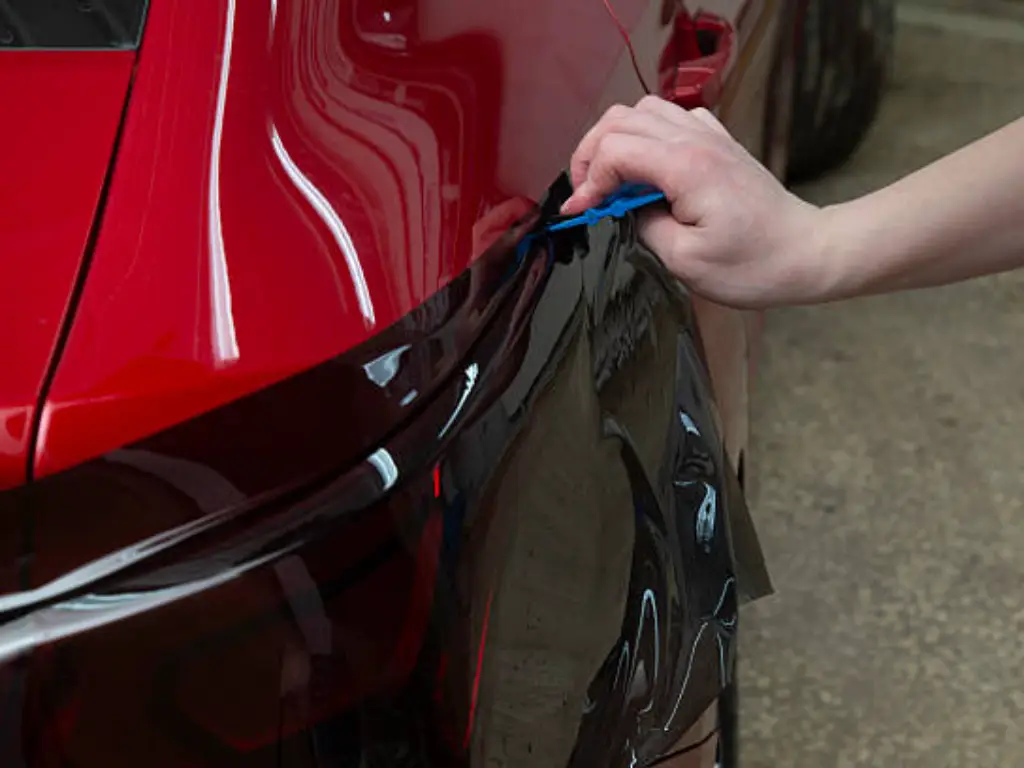
Premium TPU films drastically alter the labor equation. Since Aliphatic TPU has a naturally low Youngs Modulus and high elongation, it can be used to cover complex panels with little heat and effort. Moreover, the leading manufacturers of TPU combine their films with high-end, low-initial-tack repositionable adhesives. This enables technicians to apply the film, pick it up and re-align the position several times without leaving glue lines or stretch marks.
Although TPU needs a skilled hand and fine squeegee skills (because of its high elasticity, inappropriate tension control may result in fingering), a trained technician can apply a full-body TPU wrap much quicker than a PVC wrap.
In summary of the shop floor effect: The savings that a shop owner would have by buying cheap PVC rolls are immediately burnt by the drastically reduced human productivity, the disastrous installation yield rates (waste material through tearing), and the hard, unpaid work to remove it in the future.
Total Cost of Ownership: Procurement Versus Long-Term Profitability
To transform your business into a high-profit business as opposed to a low-margin hustle, you need to change your procurement mindset to focus on “Total Cost of Ownership (TCO) and Return on Investment (ROI)” rather than “initial roll cost.” The comparison of the TPU vs PVC material cost and ROI indicates an appalling difference in the business results.
It is a fact beyond doubt that premium Aliphatic TPU is more expensive in terms of upfront wholesale price as compared to calendered or cast PVC. But a PPF shop is not a seller of rolls of plastic; it is a seller of a long-term automotive aesthetic service.
Let us calculate the real-world business math.
When a shop is using PVC, they are able to sell at a cheaper retail price to appeal to low-end customers. But in 12 to 24 months, such PVC film is likely to turn yellow, crack or peel because of the migration of plasticizers and UV degradation. The customer returns angry. The store is now legally and ethically required to strip the failed film (which cost 10+ hours of labor), repair the damage to the paint by the aggressive adhesive, and install a new kit- all at no cost under warranty. One PVC warranty claim can eliminate the profit margin of five successful installations. The reputation of the shop is destroyed forever and the customer referral rate is zero.
When a shop employs high-quality Aliphatic TPU, the wholesale price is more expensive, yet this delivers the high durability necessary to command a premium retail price. Installation is completed faster, freeing up bay space for higher volume. Above all, the film stands the test of time. Thermal self-healing ensures a flawless finish. Five years later, the car still looks pristine. The result? Zero customer complaints. This client becomes a mobile billboard for your store, driving high-ticket referrals.
TPU vs PVC: Shop Profitability Decision Matrix
| Metric | Polyvinyl Chloride (PVC) | Aliphatic TPU (Premium PPF) | Business Impact |
| Initial Wholesale Cost | Low | High | TPU requires higher capital but supports higher retail pricing. |
| Install Time (Full Car) | 3-4 Days (High effort) | 2-3 Days (Smooth draping) | TPU increases monthly bay turnover and labor yield. |
| Warranty Claims/Failure Rate | Extremely High (>30% in 2 years) | Near Zero (<1% in 5 years) | TPU eliminates the catastrophic cost of unpaid rework. |
| Removal Labor | High (Solvents, adhesive scraping) | Low (Clean peel technology) | TPU protects the shop from liability during film removal. |
| Customer LTV & Referrals | Low (Brand damaging) | High (Brand building) | TPU drives high-net-worth referrals and repeat business. |
The ClearPro Standard: Engineering Zero-Complaint PPF Solutions
Being aware of the technical superiority of TPU is not the last step, but the key step is to have a reliable, transparent, and technologically advanced manufacturing partner. When you are in need of the most efficient TPU PPF manufacturer and a committed automotive film supplier to dealers, you cannot afford to look at mere distribution centers and consider the fundamental manufacturing capacities.
At ClearPro, we unequivocally refuse to compromise on material science. We do not engage in the race to the bottom with inferior PVC or Aromatic TPU blends. We are a vertically integrated manufacturer, not a mere private-label converter. We engineer utilizing only top-tier Aliphatic TPU, combining world-class hardware with unique chemical formulations to provide our global B2B customers with a zero-complaint PPF solution known for its superior performance.
ClearPro has transformed the ambiguous marketing term “high-end PPF” into a set of measurable, repeatable, and verifiable third-party hard engineering metrics.
Industrial-Grade Manufacturing Infrastructure
We are not a white-label assembly shop, but a primary manufacturer. We have a 3,000-square-meter, Class 1000 cleanroom, which is normally used in the production of electronic semiconductors and medical devices. This is a hyper-controlled environment with strict constant temperature and humidity controls that ensure that our coating processes are completely flawless, and that we do not have microscopic dust inclusions that plague lesser brands.
The Polyoptico™ Coating Revolution
Our research and development team has managed to incorporate clear, high gloss inorganic metal compounds into a highly cross-linked nano-polymer structure to produce our proprietary Polyoptico™ coating technology. We invite our partners to test our claims with objective hardware:
- Unrivaled Optical Clarity: ClearPro achieves a 60° gloss reading of 95 GU (12–15 GU higher than standard PPF) and a haze level of <0.9% (30% lower than mainstream brands).
- Zero Orange Peel Guarantee: Under a 500x microscope, ClearPro’s surface roughness (Ra) measures ≤0.05 µm, compared to the industry average of 0.15–0.25 µm. The result is a glass-like finish with absolutely no orange peel texture.
Extreme Performance Data
We back our Aliphatic TPU with brutal laboratory and real-world testing:
- Permanent Hydrophobicity: Our water contact angle maintains ≥105°. Even after 2,000 hours of SGS Xenon arc aging, it holds strong at ≥100°, whereas competitors degrade to 85°.
- Immortal Self-Healing: ClearPro heals >15 µm scratches instantly. In extreme laboratory testing using 30 µm copper wire brushing, our film maintained a >90% self-healing efficiency after 10,000 cycles (80°C heat activation for 30s).
- Absolute Anti-Yellowing: We have slashed the industry standard. After 5,000 hours of UVB exposure (equivalent to 7–8 years of harsh outdoor sun), our color shift is strictly controlled at Delta E less than 1.0.
- Maximum Elongation: Our film has a total thickness of 8 mil, which gives it a rate of elongation of over 400%, and retains more than 92% of its gloss even when stretched to extreme curves, virtually eliminating the waste of “stretch marks.”
Authoritative Global Certifications
Our commitment to quality is validated by international authorities. We are ISO 9001:2015, ISO 14001, ISO 45001 and the critical IATF 16949 automotive production certification. In addition, our products are compliant with the REACH and RoHS and supported by extensive SGS QUV and Xenon aging reports that can be accessed by our dealers. We have also put our money where our mouth is and have completed a 50,000 km concurrent road test on 10 vehicles in extreme conditions (Middle Eastern 50°C heat, Nordic -30°C freezes, and severe Tibetan plateau UV) with less than 3% loss in optical and hydrophobic performance.
Final Verdict: Elevating Your Automotive Business Strategy
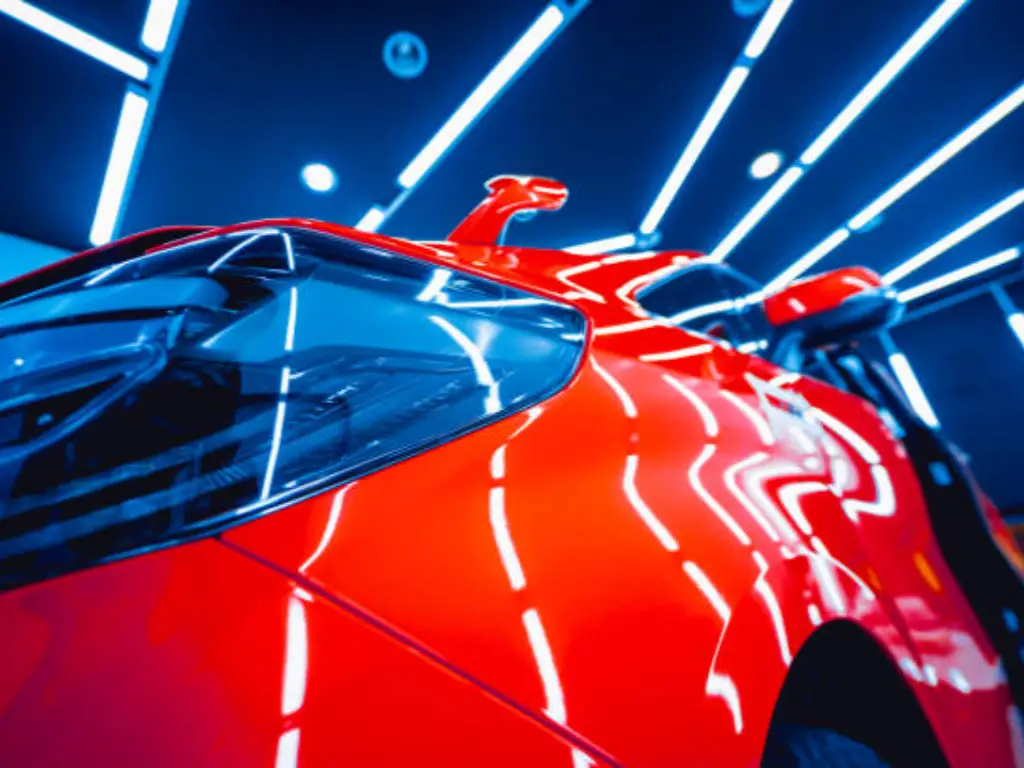
The debate between TPU and PVC is definitively settled by the laws of chemistry and the cruelties of business economics. In the context of material selection, carrying PVC or poor-quality Aromatic TPU is a shortsighted measure that temporarily boosts margins at the lethal cost of your shop’s long-term reputation. Every roll of PVC installed is a ticking time bomb of plasticizer migration, yellowing, and inevitable warranty disputes.
Conversely, choosing the right material optimizes your work output, empowers premium retail pricing, and guarantees the flawless, decade-long aesthetic protection that high-net-worth clients demand. Investing in premium Aliphatic TPU is the ultimate strategy for building an impenetrable brand moat.
Do not base your business on outdated materials. Upgrade your supply chain with verifiable, data-driven, industrial-grade PPF technology. Become a Dealer with ClearPro today. Visit ClearPro.com to download our comprehensive SGS test reports, explore our full range of transparent, matte, and color-infused Polyoptico™ PPF lines, and discover how our certified installation training and global electronic warranty system can transform your shop into a premier, high-profit automotive styling destination. Choose Clarity. Choose ClearPro.

 EN
EN  ES
ES  FR
FR  AR
AR