




A car to the majority of vehicle owners is not just a mode of transportation, but a big investment and a source of personal pride. Nevertheless, the moment a car comes out of the dealership, its exterior is constantly being attacked. It is either the microscopic grit on the highway, the acidic environment, or the friction caused by the wrong washing methods, your paint is exposed.
Understanding the various car paint damage types is the first step toward maintaining your vehicle’s aesthetic and structural integrity. This guide provides an exhaustive analysis of paint anatomy, damage identification, and the evolution from temporary repairs to permanent protection. By identifying damage signs early, you can take immediate action to prevent a small blemish from turning into a costly restoration project.
The Layered Structure: Understanding Clear Coat and Primer Depth
To identify damage, a person must be aware of what they are viewing. The modern automotive paint is not a single layer of paint color; it is a complex multi-stage system that is created to be both beautiful and durable.
- The Substrate (Metal or Plastic): The “flesh” of your car. This typically is steel, aluminum or composite plastic.
- The E-Coat (Electrocoat): This is an anti-corrosion coating that is used on the raw metal through a dipping process.
- The Primer: This is a leveler and bonding agent. It offers a smooth surface to the color and makes the paint adhesive to the substrate.
- The Base Coat (Color): This is the aesthetic layer. It contains the pigment and any metallic or pearlescent flakes. Interestingly, this layer is in fact very thin and weak in itself.
- The Clear Coat: The most critical layer for our discussion. This is a transparent, UV-resistant resin that protects the color and provides the glossy finish. Most surface damage—approximately 80%—occurs within this clear coat.
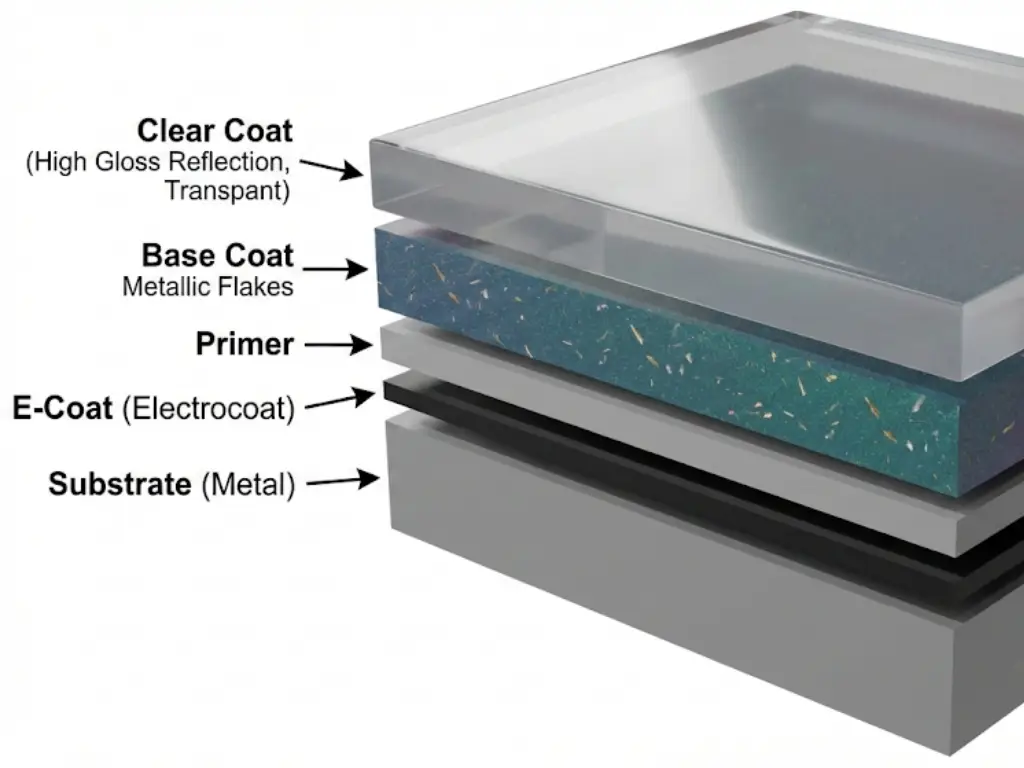
The total thickness of these underlying layers combined is often less than the thickness of a human hair (roughly 100 to 150 microns). When we talk of the “depth” of damage, we are quantifying how many of these microscopic layers have been violated.
Physical Damage Analysis: Categorizing Scratches by Severity
The most prevalent types of car paint damage are physical in nature. These are usually mechanical, brought about by physical impacts or friction. To identify the most appropriate course of action, we classify scratches according to how deep they penetrate the paint surface.
The “Fingernail Test”
This is the gold standard for DIY diagnosis. Gently run your fingernail across the scratch.
- If your nail does not catch: The damage is likely limited to the upper portion of the clear coat. These are considered minor scratches and can usually be polished out without adding new paint.
- If your nail catches: The scratch has reached the primer or the metal. This cannot be corrected by simple polishing; it needs professional help or a “fill and paint” procedure to avoid structural deterioration.
Damage Categories:
- Swirl Marks: Small scratches that can be seen in the form of spider-webs when in direct sunlight. They are commonly caused by inappropriate washing methods, e.g. circular motions with dirty sponges that scratch grit on the surface.
- RIDS (Random Isolated Deep Scratches): Individual scratches that often occur during drying or when someone brushes against a dirty car in a crowded parking lot. They are deeper than swirls and require localized car paint correction.
- Clear Coat Scratches (Level 1): Visible but do not change the color of the car. They occupy the top 25% of the clear coat and re-emerge as soon as the surface dries.
- Deep Scratches (Level 2 & 3): If you see white or grey primer, you have significant damage. These are “entry points” for moisture, which may cause sub-surface corrosion where rust spreads under the paint.
- Rock Chips: High-speed debris punches through all layers, creating jagged craters that entrap dirt and wax, increasing the risk of further damage over time.
Chemical Corrosion: How Environmental Hazards Eat Your Paint
Chemical damage is usually “etching,” where environmental contaminants or harsh chemicals form a reaction that literally dissolves the clear coat molecules.
The Time Sensitivity Factor
The temperature and the “Expansion/Contraction Cycle” are vital to environmental damage. When it is hot, the clear coat swells and becomes soft, enabling contaminants like bird droppings to sink into the porous, heated surface. When the temperature decreases at night, the clear coat shrinks and “locks” the contaminant into the texture. This is why a bird dropping sitting on a hood in 35°C heat for four hours can do more structural damage than a week in cooler weather.
- Bird Droppings & TreeSap: Highly concentrated with uric acid and resins. If allowed to dry, they “cook” into the paint, leaving a permanent wrinkled feel.
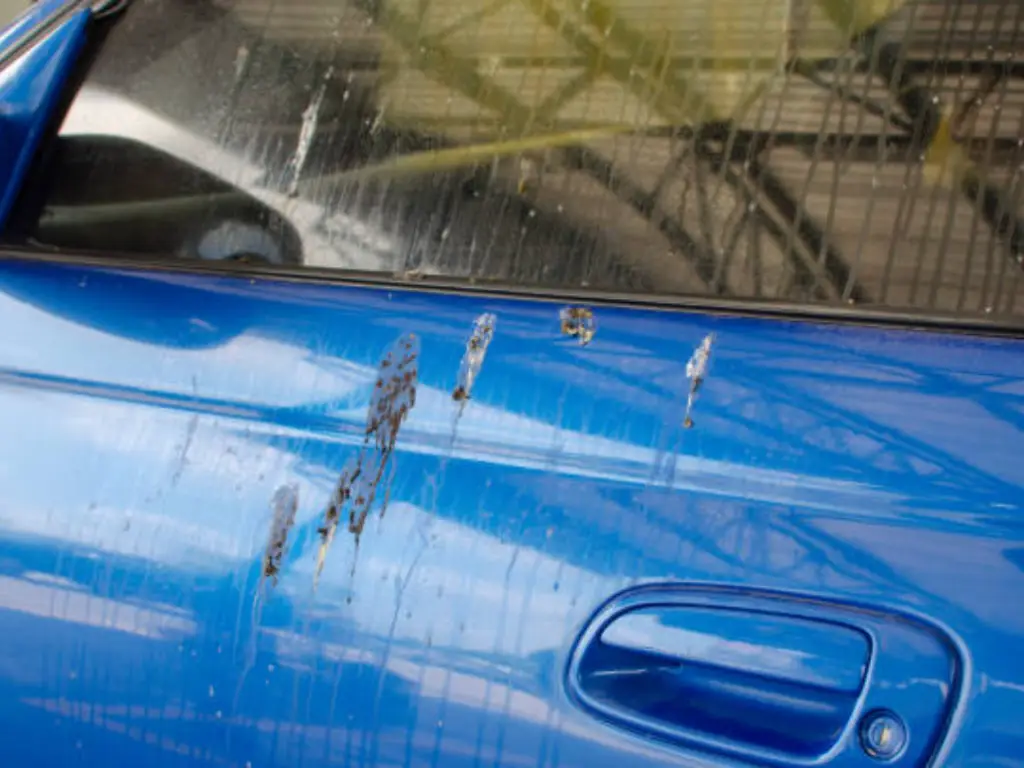
- Acid Rain & Hard Water Spots: When environmental elements mix with moisture, they create an acidic film. As water evaporates, the acid concentration increases, etching circular “rings” into the clear coat.
- Industrial Fallout: Minuscule metal dust from train brakes or factories falls on your paint. They oxidize immediately when wet, forming small orange “rust blooms” that feel like sandpaper.
- Road Salt: In winter climates, road salt is a primary cause of accelerated corrosion. Constant chemical exposure to salt can degrade the clear coat and eat into the metal substrate if regular washing is neglected.
Soft vs. Hard Paint: How Your Car Brand Affects Damage
Not all car paint is created equal. The chemical formulation, i.e. the ratio of resin to activator, employed by the manufacturer determines the “hardness” of the clear coat. This hardness dictates how easily the car scratches and how much effort is required to restore it.
- Soft Paint (Common in Japanese & Tesla vehicles): Brands like Mazda, Honda, Toyota, and Tesla are notorious for “soft” clear coats.
- The Mechanics: Soft paint is more “malleable.” Although this is good, it implies that the surface is not resistant to friction. Even a high-quality microfiber towel, if used with slightly too much pressure, can leave microscopic marring.
- Pros: It is unbelievably fixable. Deep swirls can be removed by a professional using comparatively mild polishes and low-speed machines.
- Cons: It is a Swirl Marks magnet. Such vehicles demand touchless maintenance plans. Moreover, soft paint is prone to “sticky” tendencies during polishing with heat making the paint stick to the polishing pad.
- Hard Paint (Common in German & European vehicles): Brands like BMW, Audi, Mercedes-Benz, and Volkswagen typically use ceramic-infused or high-solid clear coats.
- The Mechanics: These paints are meant to be used in high-speed Autobahn and industrial durability. The molecular structure is far more dense and the surface is much more scratch-resistant.
- Pros: Excellent resistance to the “spider-webbing” caused by automatic car washes and environmental debris.
- Cons: Its biggest weakness is Brittleness. Because the paint is so hard, it doesn’t “flex” upon impact. When a rock strikes a German vehicle the paint will tend to crack or peel off in a big piece instead of simply scratching. To detailers, hard paint is a nightmare that is labor intensive; it can take hours of heavy compounding with violent wool pads to remove one deep scratch.
It is important to know what kind of paint you have: trying to use a “Hard Paint” correction method on a Tesla may end up buffing through the clear paint in a few minutes.
Application Defects: Identifying Factory and Body Shop Errors
In some cases, the road or the environment is not the cause of the “damage,” but the painter. It is important to differentiate External Damage and Application Defects to control quality after a repair or during a pre-purchase inspection of a used car.
- Orange Peel: This is a textured surface that mimics the pitted skin of an orange. It occurs when the paint doesn’t “level out” smoothly before the solvents evaporate. Although nearly every modern factory car has some slight amount of orange peel (because of thin, environmentally-friendly water-based paints), a non-uniform or excessive texture on a single door is a “smoking gun” that the panel has been repainted in a non-factory setting.
- Fisheyes: These appear as small, circular craters with a dark center. They are brought about by silicone contamination, usually through the adjacent tire shines or oil sprays, on the panel when the painting is done. The paint literally “runs off” the contaminant leaving a hole.
- Solvent Pop: These look like tiny, uniform pinholes or “sand” trapped under the clear coat. They are caused by the top layer of paint becoming “skinned over” too fast, and leaving solvent gases trapped beneath. The gases become hot and burst through the surface like small bubbles. This is a structural defect; these holes may later permit the moisture to penetrate the base coat.
- Buffing Trails / Holograms: Often called “ghosting,” these are iridescent, oily-looking patterns that dance under sunlight. They are brought about by a technician operating a high-speed rotary polisher improperly, basically cutting a design into the clear coat. These are additive defects that are the result of bad finishing work, unlike scratches, and are the mark of a “rushed” body shop job.
- Dry Spray: This occurs when the paint gun is held too far away, causing the paint droplets to partially dry in the air before hitting the car. The outcome is a coarse, matte-like finish which does not mirror the rest of the car.
DIY vs. Professional Repairs: Techniques, Costs, and Common Pitfalls
The choice of whether to repair a scratch yourself or give the keys to a professional is determined by two things: the severity of the damage and your risk-taking ability. Although DIY techniques are cost-effective, any error made on the wrong kind of damage may result in the irreversible failure of the clear coat.
The Repair Decision Matrix
| Damage Type | Repair Suitability | Why? | DIY Cost | Pro Cost |
| Swirl Marks | Ideal for DIY | Only affects the surface; low risk of permanent error with a DA polisher. | $50 – $150 | $300 – $600 |
| Light Scratches | Suitable for DIY | If it doesn’t catch your nail, a hand-applied compound can level it. | $20 – $60 | $150 – $300 |
| Deep Rock Chips | Borderline | DIY kits exist, but matching color and level is difficult for beginners. | $30 – $80 | $200 – $500 |
| Exposed Primer | Professional Only | Requires multi-layer filling and precision blending to prevent rust. | N/A | $400 – $800 |
| Clear Coat Failure | Professional Only | Once the clear coat peels (delamination), the entire panel must be resprayed. | N/A | $600 – $1,200 |
Common DIY Techniques
- The Clay Bar Method: Used to remove industrial fallout and “rough” surface contaminants before polishing.
- Machine Polishing: Utilizing a Dual-Action (DA) polisher to safely “shave” microns of the clear coat to remove swirls.
- Wet Sanding: A high-level DIY skill for removing deep scratches, involving ultra-fine sandpaper (3000+ grit) and water.
Core Pitfalls and “The Point of No Return”
The biggest trap for DIYers is over-polishing. On Soft Paint (as on Tesla or Mazda), the clear coat is extremely thin. Aggressive compound can be used to “burn through” to the base coat in a few seconds. When you notice the color of the paint on your polishing pad, it is too late–the panel has to be repainted by a professional.
Another common pitfall is the “Touch-up Blob.” Many owners use a touch-up pen to fill a chip but fail to level it, resulting in a permanent, unsightly bump that is often more noticeable than the original chip.
From Repair to Prevention: Modern Restoration and Protective Solutions
After determining the nature and extent of the damage to the paint on your car, the discussion now moves to action. This process is split into two separate stages: Restoration (reparation of the damage of the past) and Prevention (protection against the threats of the future). It is important to know the finer details of each to ensure that the finish is “showroom” finish throughout the life of the car.
Phase 1: Restoration Techniques (The “Cure”)
Restoration is the mechanical process of removing or filling defects to return the paint to its original flat, reflective state. Depending on the severity of the damage, professionals and enthusiasts use four primary methods:
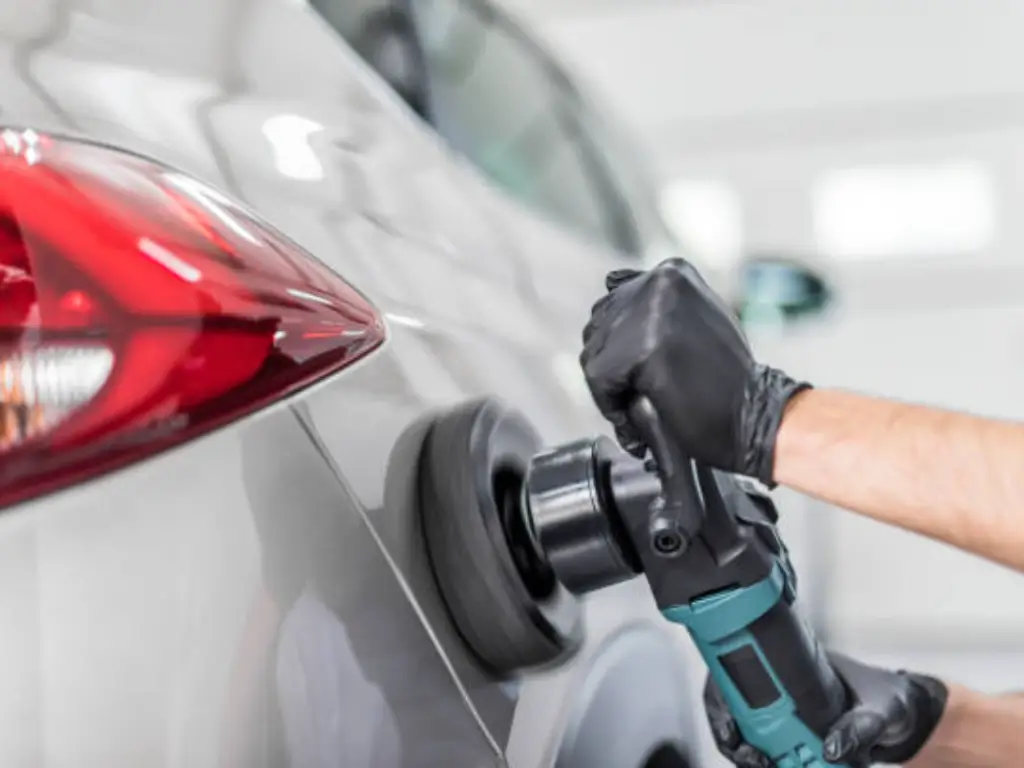
- Polishing & Compounding: This is the most widespread type of “Paint Correction.” It is the application of abrasive liquids (compounds to deep defects, polishes to finish) to microscopically hone the clear coat until it is even with the bottom of the scratches.
- Best for: Swirl marks, holograms, and light oxidation.
- Touch-up Paint: Once the base coat or the primer has been penetrated by a scratch or a rock chip, it is no longer possible to polish. The resin is filled in the void with a color-matched resin.
- Best for: Small rock chips and narrow, deep scratches.
- Wet Sanding: This is a violent restoration method that is applied to deep clear coat scratches or “Orange Peel” texture. By using ultra-fine sandpaper (typically 2000 to 5000 grit), the surface is leveled before being brought back to a gloss via heavy compounding.
- Best for: Severe surface defects and texture leveling.
- Professional Respraying: Once the metal is damaged or the clear coat (peeling) has been experienced, the only option is to strip the panel and repaint it with a new factory-spec paint system.
- Best for: Major accidents, deep keys scratches, and sun-faded clear coats.
Phase 2: Protective Solutions (The “Shield”)
Restoration is subtractive in nature- it removes clear coat. In order to prevent this cycle, a protective layer should be introduced. The following is the comparison of modern protection options:
- Car Wax & Sealants: The traditional choice. Waxes are warm and simple water bead-off and have no protection against physical hits and only a few weeks of life.
- Ceramic Coatings: A liquid polymer that chemically bonds with the vehicle’s factory paint. It creates a semi-permanent, hydrophobic layer that excels at resisting chemical corrosion (bird droppings, acid rain) and UV rays. However, it is too thin to stop rock chips.
- Paint Protection Film (PPF): Commonly known as a “Clear Bra,” this is a thick, high-impact urethane film. It is the only solution that provides a physical barrier against rock chips, road debris, and deep scratches.
- The Hybrid Approach (PPF + Ceramic): For the ultimate protection, many owners apply a ceramic coating over the PPF. This is a combination of the impact resistance of the film and the extreme self cleaning properties of the coating.
Elevating Protection: The ClearPro Innovation
ClearPro reinvents the line between “average” and “extraordinary” in the high-end protection market. In contrast to other brands that simply name generic films, ClearPro is a professional manufacturer with a 3,000㎡ Class 1000 dust-free workshop, a medical-grade environment that guarantees the film has no microscopic defects. This accuracy is supported by IATF 16949 and ISO 9001 certification, which ensures a product that does not have the usual frustrations of the industry such as bubbling and delamination.
Data-Driven Defense with Polyoptico™ Technology
To solve the specific paint issues discussed in this guide, ClearPro developed Polyoptico™, a proprietary cross-linked polymer structure that delivers measurable results:
- Total Optical Clarity: It has a 95 GU gloss rating and a haze of less than 0.9%, which is aimed at the “Orange Peel” effect discussed above, and improves the factory finish of your car instead of making it dull.
- Physical Resilience: It is long-term self-healing and has a healing efficiency of over 90% after 10,000 abrasion cycles, which is much longer than standard films which typically fail after 3,000.
- Climate-Tested Durability: Proven through 50,000 km of real-world testing—from 50°C desert heat to -30°C arctic cold—ClearPro maintains a 105° hydrophobic angle and resists yellowing (ΔE<1.0), even under intense UV exposure.
Whether opting for transparent, matte, or carbon fiber finishes, ClearPro provides a 10-year factory-backed warranty. For owners seeking to end the cycle of constant paint repair, ClearPro transforms “Feel The New Clarity” from a slogan into a quantifiable, data-driven shield for your investment.
Paint Condition and Resale Value: Why First Impressions Matter
Although most car lovers keep their paint because of the beauty, there is a major financial fact behind all the scratches and swirls: Residual Value. The exterior condition is the most important indicator that appraisers and individual buyers use in the automotive secondary market to determine the overall well-being of a vehicle. A car’s paint is its “biography,” telling a story of either meticulous care or prolonged neglect.
The Psychology of the Buyer
When a prospective customer walks up to a car, a “first impression” is created in the ten seconds. This is referred to as Visual Premium. When the paint is bright, smooth and free of blemishes, the buyer subconsciously believes that the mechanical parts, the engine, transmission and suspension, have been handled with the same level of discipline.
Conversely, a car covered in bird-dropping etchings, “orange peel” from poor resprays, or a “sandpaper” texture from industrial fallout signals a red flag. Poor paint condition to an appraiser indicates that the vehicle was probably parked outside, washed rarely and maybe not maintained in other important aspects.
The Financial Impact: A Data-Driven Look
In professional valuation guides (such as Kelly Blue Book or Black Book), the difference between a vehicle in “Excellent” condition and one in “Fair” condition can be staggering.
- The 15% Rule: The average car with extensive paint wear (e.g. extensive oxidation or deep key scratches) will lose 10% to 15% of its resale value. That is a loss of equity of $9000 on a $60,000 luxury SUV.
- The “Original Paint” Premium: Collectors and high-end buyers place a massive premium on Original Equipment Manufacturer (OEM) paint. The modern paint depth gauges enable the buyers to know whether a panel has been repainted or not. A car that has its original factory finish in good condition will almost always be priced higher than a car that has been resprayed to conceal the damage since “factory-applied” paint is believed to be better in terms of durability and color matching.
Preservation as a Strategy
Finally, the expense of repairing or protecting paint cannot be considered a sunk cost, but as an investment in equity maintenance. An owner is virtually “locking in” the future value of the car by fixing chemical corrosion at an early stage and eliminating physical abrasions before they get to the primer.
At the point of time to trade in or sell, a vehicle that has not lost its showroom clarity does not simply fetch higher, it sells quicker. In a saturated market, the car that glistens the most is the one that travels the fastest. It is not only a matter of pride of ownership, but keeping your car paint is the best way of making sure that your second-largest investment in life pays the maximum when you are ready to upgrade again.

 EN
EN  ES
ES  FR
FR  AR
AR