




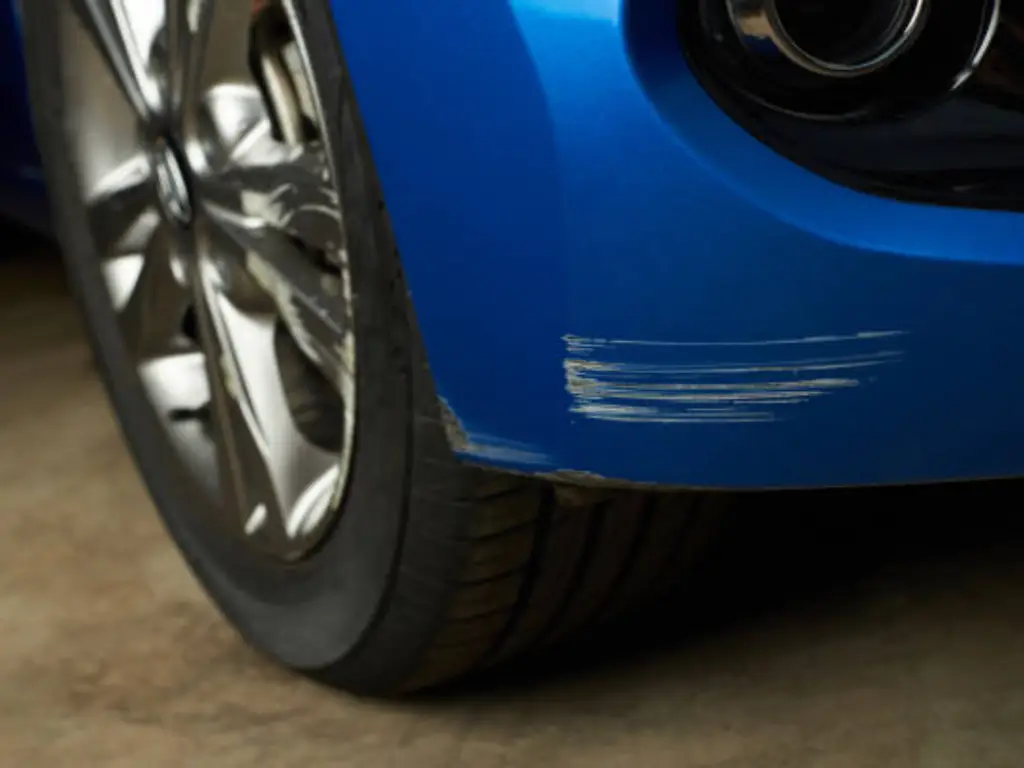
It starts with a sinking feeling in your stomach. Maybe you’re returning to your car in a crowded parking lot, or perhaps you caught that cringe-inducing sound of a stray branch scraping against your door. A scratch on your car is never just a cosmetic flaw; it’s a frustrating setback, a potential blow to your wallet, and—if ignored—a ticking rust time bomb.
The landscape of automotive repair has shifted in 2026. The car paint scratch repair cost has climbed as paint technology grows more sophisticated, and the gap between a “quick fix” and a “factory-standard” repair has never been wider. Whether you’re driving a reliable daily commuter or a high-performance luxury vehicle, understanding the real car scratch repair cost is essential to making the right choice for your investment.
So, is this a project you can tackle in your driveway, or is it a job for the experts? This guide breaks down the actual expenses, the hidden risks, and the modern solutions available to car owners today to fix paint damage.
Identify Your Scratch: The Fingernail Test and Depth Guide
Before you can ask, “how much does it cost to fix a scratch on a car,” you have to understand the severity of the injury. Not all scratches are created equal. Think of your car’s paint as a sandwich of layers: the metal body, the primer, the base coat (color), and the clear coat (protection). The extent of the damage determines both the repair method and the final price tag.
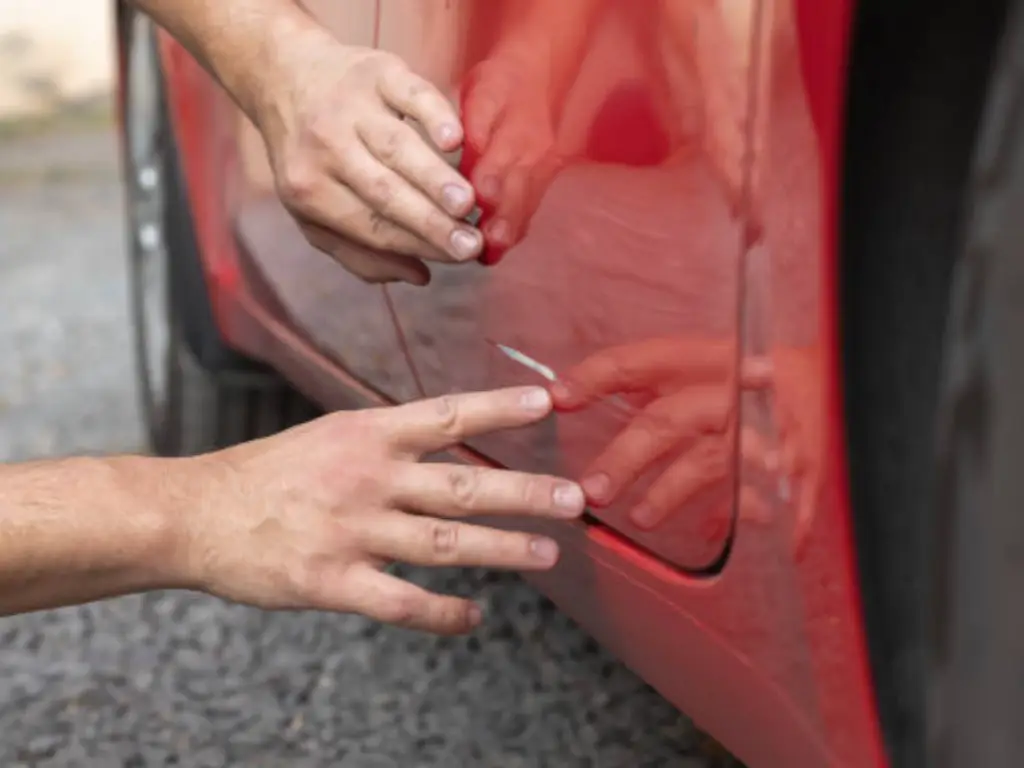
The most reliable diagnostic tool is likely already in your hand: the “Fingernail Test.” Run your fingernail perpendicular across the mark and observe the results:
- If your fingernail glides over without catching: You likely have a clear coat scratch. This is superficial damage that hasn’t yet breached the color layer.
- If your fingernail catches slightly: You have likely reached the paint (base coat) layer. The clear coat is compromised, leaving the color exposed to the elements.
- If your fingernail drops into a deep groove: You are dealing with a deep gouge. The damage has penetrated through the primer and likely reached down to the metal.
The “Rust Alert”
Diagnosing depth isn’t just about vanity; it’s about structural integrity. If you see a glimpse of grey or white, you’re at the primer level. If you see shiny silver or dark steel, you’ve reached the underlying metal.
This is a critical “Rust Alert.” The moment bare metal is exposed to moisture and oxygen, oxidation begins. By 2026, with the industry moving toward thinner, eco-friendly sheet metals, rust can spread beneath the surrounding paint much faster than you might expect. A deep scratch that would cost $400 to fix today could easily spiral into a $2,000 full-panel replacement if corrosion is allowed to take hold for even a few months.
2026 Professional Pricing: Costs by Depth and Panel Type
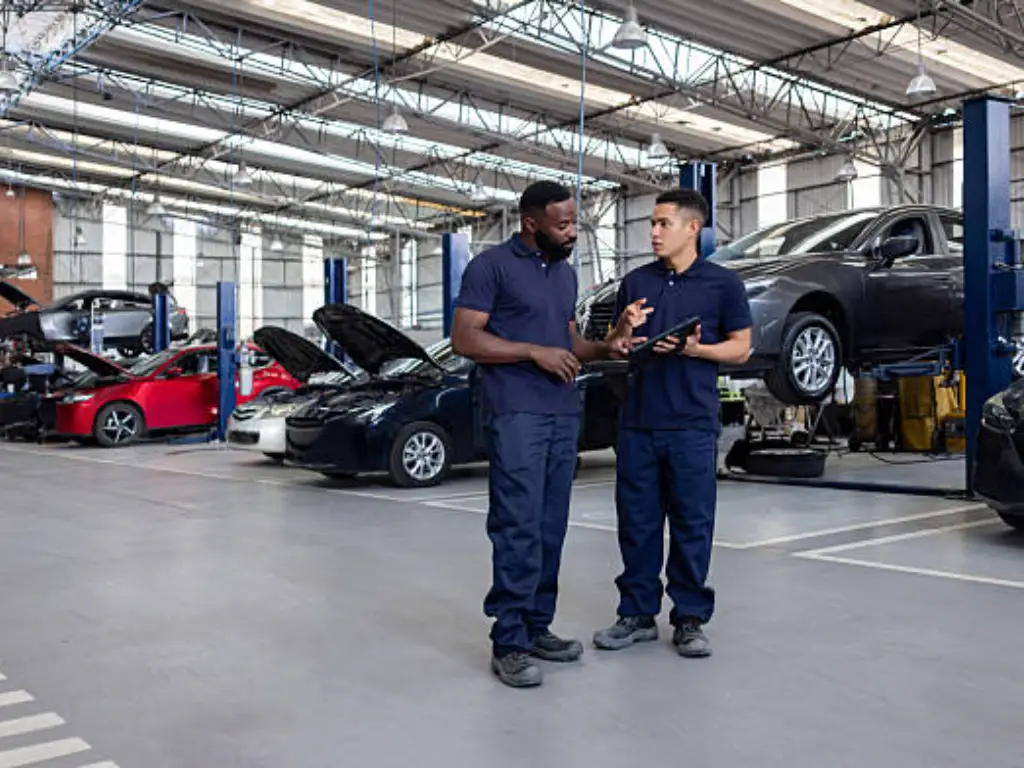
The most frequent question that car owners ask is, “how much does it cost to fix a scratch on a car?” Professional repair isn’t just about filling a crack; it is about blending. To make sure that a scratch disappears without leaving any traces, an auto body shop must sand the surrounding area, apply a primer, spray the base coat and in most cases clear-coat the entire panel to match the texture.
The labor rates have been stabilized at a higher rate by 2026 due to the shortage of skilled technicians and the price of materials involved in the production of eco-friendly water-borne paints has increased. Here is a breakdown of what you can expect to pay based on the severity of the scratch:
| Scratch Severity | Typical Damage Type | Repair Method | Est. Cost (Independent Shop) | Est. Cost (Dealership) |
| Level 1: Surface | Swirl marks, light scuffs | Wet sand & Multi-stage Polish | $150 – $300 | $250 – $450 |
| Level 2: Paint Layer | Key scratches, shopping cart dings | Spot putty, paint blend, clear coat | $400 – $800 | $600 – $1,100 |
| Level 3: Deep/Primer | Vandalism, deep parking scrapes | Sand to bare, primer, paint, blend | $800 – $1,500 | $1,200 – $2,000+ |
| Level 4: Metal/Rust | Accident impact, neglected deep scratches | Rust removal, potential dent pull, full repaint | $1,200 – $2,500+ | $2,000 – $3,500+ |
Understanding the Quote Variance
You might visit three stores and get three insane quotes on your car. This is not necessarily price gouging but it is based on the individual who is doing the repair and where they are located.
- Shop Tiers: Why Dealerships Charge More
- Tier 1: Dealerships (The Premium Option): Dealerships are the most overhead. They work with OEM (Original Equipment Manufacturer) parts and paint codes are followed to the letter and their technicians have been trained on specific brands. You are paying the stamp of “Authorized Service” in your vehicle history report that usually attracts a 30-50% premium over independent shops.
- Tier 2: Certified Independent Shops (The Sweet Spot): These are good quality body shops that invest in professional equipment (such as downdraft spray booths) but have lower marketing and facility expenses than dealers. They tend to provide the most appropriate price-quality ratio.
- Tier 3: Economy Chains (The Budget Option): These stores are volume and speed oriented. They might tape off door handles instead of removing them, leading to visible “tape lines” or overspray. The finish is usually not long lasting, although it is cheaper.
- The Location Factor: Urban vs. Suburban
The final bill can vary significantly by zip code, with labor rates being the primary driver of repair costs.
- Major Metro Areas (e.g., NYC, LA, San Francisco): Labor rates may be extremely high ($120-$180 per hour) because of high rent and wages.
- Suburban/Rural Areas: Within an hour of the city, the labor rates could go down to $60-$90 per hour.
- The Impact: On a complicated 10-hour repair job of a deep scratch on two doors, a drive to a suburban shop would save you almost $1,000 in labor expenses alone.
Hidden Cost Factors: Paint Technology and Vehicle Tech
In addition to the shop you select, the type of vehicle you drive determines the minimum price. In 2026, cars are more than just metal; they are rolling computers wrapped in high-tech pigments.
The “Luxury Tax” on Paint Complexity
Modern automotive paint is no longer just “Red” or “Blue.”
- Tri-Coat and Pearl Finishes: Colors like “Pearl White” or “Mazda Soul Red” require a three-stage application: a base coat, a translucent pearl mid-coat, and a clear coat. It is extremely hard to match the density of pearls. This additional measure adds about 20-30% to the cost of materials and labor.
- Matte and Satin Finishes: These are the costliest finishes to maintain. A matte car cannot be buffed or polished to take away a scratch since polishing it will make it shiny and it will destroy the matte effect. One scratch can easily necessitate the repainting of the whole panel–and even the blending into the other panels–to make the finish even.
- Aluminum vs. Steel: Luxury vehicles (like the Ford F-150 or high-end Audis) often use aluminum panels. Aluminum is more difficult to remodel than steel, and it has a “memory,” which means that special tools are needed and separate “clean rooms” are required to avoid galvanic corrosion. This specialization is priced high.
ADAS Sensor Recalibration
Does your bumper have parking sensors? Does your side mirror have a camera? When a scratch repair requires the removal of a bumper or a mirror, the Advanced Driver Assistance Systems (ADAS) will usually require recalibration.
- The Cost: Even a basic bumper repair and respray could cost you an extra $300-$600 to have the electronic recalibration done to make sure that your blind-spot monitoring system is functioning properly. Ignoring this step can compromise your safety features.
- The Paradigm Shift: From Repair to Preservation: With the convergence of these high-tech pigments and sensitive electronic safety systems, the 2026 car paint scratch repair cost has reached a tipping point. Since it now takes complicated blending and technical recalibration to fix a single deep scratch, which can easily cost over $1,500, a lot of luxury and EV owners are changing their priorities. Rather than taking the risk of the expensive and structural compromise of a conventional repair, the industry is experiencing a colossal shift to high-end preservation techniques. It is becoming more and more evident that the only sure way of avoiding these “hidden costs” is to make sure that the factory finish is not violated at all.
DIY Repair Costs: Kits, Pens, and When to Avoid Them
If the professional price tags are inducing anxiety, you might be considering the DIY route. For Level 1 and some Level 2 scratches, this is a viable option. But it takes time, a steady hand and a profound knowledge of the dangers involved.
The Real Cost of DIY
- Touch-up Pens ($15 – $30): Best for small chips from rocks. They are not always seen to be perfect on long scratches because they tend to leave a raised “blob” of paint. They coat the metal and do not refinish it.
- Scratch Removal Kits ($30 – $60): These usually contain a clarifying compound and a buffing pad. They work on clear coat scratches but not on those where the paint has been removed.
- Aerosol Spray Cans ($50 – $100): For the brave. Require to buy primer, base coat (color-matched) and 2K clear coat.
Why Most DIY Attempts Fail: The “Hidden” Risks
Although the temptation of a $30 repair is high, the “DIY Disaster” is one of the main sources of revenue of professional body shops in 2026. The environmental and chemical variables are important to understand in order to prevent an expensive error when attempting various diy methods.
- The Temperature Trap: Most DIY kits require a stable temperature of 20°C – 25°C (68°F – 77°F). In 2026’s thinner paint systems, temperature control is non-negotiable. If you attempt a touch-up in a humid driveway or a cold garage, the paint will not “flow” or level properly. It will pile up forming a visible ridge which will serve as a magnifying glass to the scratch instead of concealing it.
- The Clear Coat “Halo”: This is a typical error of purchasing a color-matched pen and omitting the clear coat. The clear coat provides UV protection to the spot that is “fixed,” so that without it, the spot will oxidize at a different rate than the rest of the car, becoming a dull, chalky gray in 6 months of sun exposure.
- Over-Sanding & “Burn Through”: In the process of trying to flatten out a scratch, most DIYers over-sand the clear coat of the surrounding healthy paint. This forms what is known by professionals as a “Burn Through.” Once you breach the clear coat, you create a permanent “ring” or “halo” that cannot be buffed out; it can only be fixed by repainting the entire panel.
- The “Toothpaste Myth”: Internet “hacks” often suggest using household items like toothpaste to buff out scratches. Although toothpaste has mild abrasives, it also has chemicals that can soften some of the modern clear coats. In the eco-friendly paint systems of 2026, the wrong abrasive will leave a permanent haze that appears as a smudge of grease that cannot be washed off and will have to be fixed by a professional compounding.
The “Point of No Return”
There is a limit that you must not overstep. Do not attempt to DIY if the scratch is down to the metal or covers a large surface area (like a keyed hood).
Amateur spraying often results in “orange peel” (a bumpy texture), dry spray, or severe color mismatch. We see car owners spending $100 on supplies, ruining the finish, and then giving a professional another sum of money to sand down the shoddy DIY job before fixing the original scratch. Unless you are sure of your technical capability or the conditions under which you are operating, the risk is normally greater than the savings.
Modern Solutions: Mobile Technicians and AI Paint Matching Costs
The automobile repair business has changed a lot. You do not have to leave your car in a shop and wait a week in 2026.
Mobile Scratch Repair (“Smart Repair”)
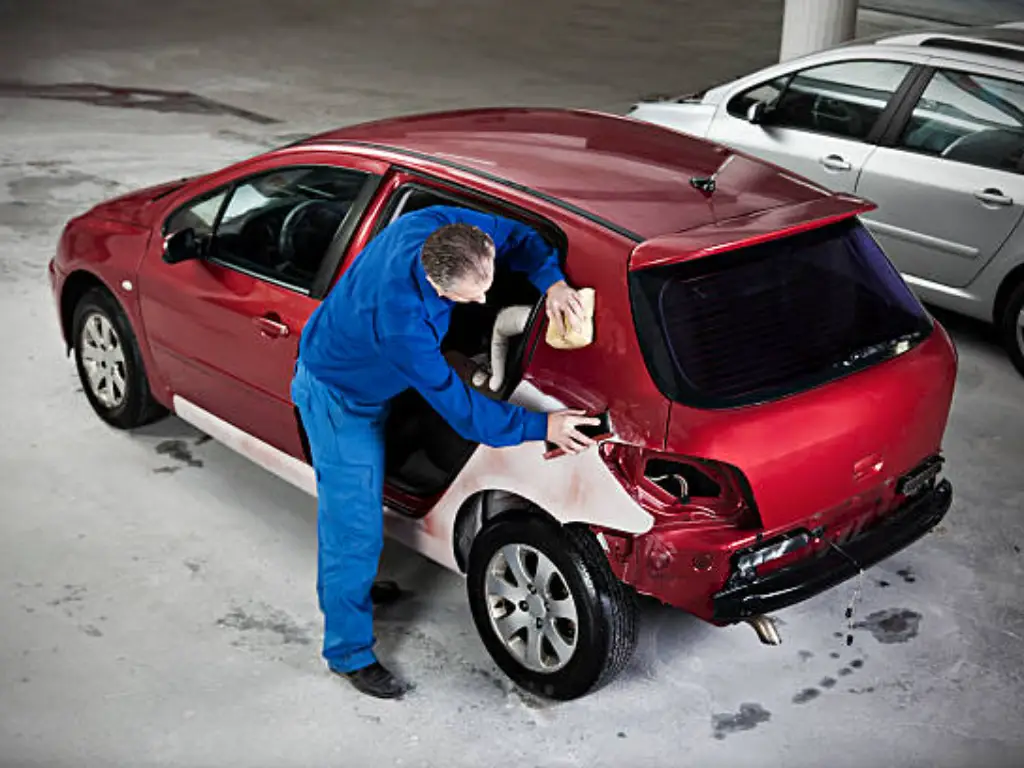
Mobile technicians bring the body shop to your driveway. They apply airbrush to fix the damaged part, but not the entire panel.
- Cost: Typically 30-50% cheaper than a brick-and-mortar body shop ($200 – $500).
- Pros: Incredible convenience; usually done in 2-4 hours.
- Cons: They cannot repair large areas outdoors due to dust and humidity control. Best for bumper scuffs and small door scratches.
AI Paint Matching
The greatest fear of repair is color mismatch. Spectrophotometers connected to AI databases are now used in modern shops. This device scans your car’s current paint (which may have faded slightly from the factory code due to sun exposure) and adjusts the mixing formula instantly. This technology is a minor addition to the price of materials but ensures a 99.9% color match, which removes the nightmare of the “two-tone” appearance of cars where the door does not match the fender.
The Insurance Dilemma: Deductibles vs. Out-of-Pocket Expenses
The fact that you are fully covered does not mean that you should use it. Filing a claim for a scratch is a mathematical decision, not an emotional one. In the 2026 insurance market, underwriters have become increasingly aggressive with “minor claim” surcharges.
The Calculation Logic
The majority of standard deductibles are $500 or $1000.
The Formula: Repair Cost vs. Deductible + Future Premium Increase (3-5 years)
If your repair costs $850 and your deductible is $500, the insurance only pays $350. Nevertheless, a claim remains on your C.L.U.E. (Comprehensive Loss Underwriting Exchange) report up to 7 years. One claim can increase your premiums by 20%-40%. In three years, such a premium increase would cost you $1,500.
The Verdict: It is nearly always more economical to pay out-of-pocket to have your car repaired in a scratch to save your insurance record unless the damage is serious (more than $2,000) or it involves another vehicle.
Resale Value Impact: Fixing Scratches Before You Sell
You might think, “I’ll just sell the car as-is; let the next guy fix it.” This is usually a losing tactic. The main factor of “Curb Appeal” is visual condition. A vehicle that has noticeable scratches informs a buyer that the vehicle was not taken care of and he or she would be wondering what other mechanical care was not done.
Cosmetic defects in the market analysis can reduce a trade-in offer by 10%-15%. It can be a good idea to spend $500 to repair a bumper and sell it at a higher price of $1,500.
Why Modern Buyers Prioritize Original Factory Paint
The high-end and enthusiast market is becoming more and more savvy. They also have paint depth gauges to identify repainted panels. Why? Original factory paint is impossible to replace. Even the finest body shop cannot exactly duplicate the robotic accuracy and high temperature baking of the factory line. A repainted panel is a cause of suspicion of the previous accidents, which automatically reduces the value of the vehicle.
This is where the conversation shifts from “repair” to “preservation,” and where ClearPro is redefining the standard.
ClearPro being a manufacturer of high-performance automotive films knows that the best way to deal with a scratch is to ensure that it does not come into contact with the paint at all. We have a manufacturing capacity that competes with the electronics and medical industries, which supports our philosophy, which is “Feel The New Clarity.”
Why ClearPro PPF is the Ultimate Value Protector:
- Self-Healing Performance through Precision Engineering: Utilizing our exclusive Polyoptico™ coating technology, ClearPro Paint Protection Film (PPF) features a dense, cross-linked nano-material structure. This advanced chemical architecture allows the film to sustain over 90% recovery efficiency even after 10,000 cycles of surface contact in laboratory testing. For the car owner, this means that most common surface swirls and light abrasions are no longer permanent damages; they are temporary marks designed to vanish upon exposure to moderate heat or direct sunlight, maintaining a “showroom” finish indefinitely.
- Zero Orange Peel Clarity: We have a Class 1000 clean room (3000㎡) that is highly controlled in terms of temperature and humidity. This will enable us to promise the industry the only “Zero Orange Peel.” Under a 500x microscope, our surface roughness (Ra) is ≤0.05 µm, compared to 0.15–0.25 µm for competitors. Your car does not look like it is wearing plastic, it looks like liquid glass.
- Optical Superiority: We don’t just protect; we enhance. ClearPro film delivers a 60° Glossiness of 95 GU (12-15 GU higher than standard PPF). It makes your paint look deeper and wetter than the day it left the factory.
- The 10-Year Promise: We back our technology with a 10-year warranty against yellowing, cracking, and blistering, supported by ISO 9001, ISO 14001, and IATF 16949 certifications.
When you wrap your vehicle in ClearPro, you are not only saving the $1,000 trip to the repair shop, you are also preserving the original factory finish, which means that when you sell your car, you are selling a perfect car.
Pro Tips to Minimize Costs and Prevent Future Scratches
When you have just paid to get your car fixed, or when you have a new car that you want to keep in good condition, it is much cheaper to prevent than to cure.
- Parking Strategy: The “Far Corner” rule works. Park away from the store entrance to avoid shopping carts and door dings.
- Ceramic Coatings: These liquid polymers create a hard, hydrophobic shell. Although they make the car easier to wash and guard against bird droppings, it is important to note that ceramic coating does not guard against physical scratches of keys or rocks.
- The Ultimate Shield: For high-level physical impact protection, Paint Protection Film (PPF) is the most robust solution available. A high-quality film acts as a durable, transparent sacrificial layer between the environment and the vehicle. It is specially designed to absorb the energy of stone chips, road debris and abrasive brushes so that the impact is absorbed in the film and not in the fragile factory paint below. This proactive approach eliminates the need for frequent corrective polishing or costly respraying.
To implement this proactive defense effectively, comparing material specifications across [an audited selection of leading paint protection films] is the most logically sound step to ensure your vehicle receives the exact abrasion resistance required.
Conclusion
The cost of scratch repair in 2026 is more than ever due to the complicated paint finishes, inbuilt vehicle sensors, and the increasing labor rates. Although DIY can still be considered as a viable option when dealing with minor surface blemishes, professional restoration is the only solution that can be used to restore the value of a vehicle after it has suffered a major damage. Finally, the most economical approach is not to seek the lowest price to repair the damage but to avoid it. It may be by being a conscious parker or spending money on good quality paint protection, but preserving your original factory finish is the most financially sound choice any car owner can make.

 EN
EN  ES
ES  FR
FR  AR
AR